
Having solar panels on your roof already does not stop you from claiming a home battery rebate in Victoria. Households that already have solar are the group the current storage discounts suit best. Whether you can claim comes down to a short list of checks. You need to know which program applies, how much usable storage you’re adding, whether your existing setup can connect to it, and whether the discount appears on a written quote.
This checklist is for Victorian homeowners with a working solar system who want to add storage. We’ve helped Victorian households claim energy upgrade incentives since 2014, and the same mistakes keep coming up. Most of them start with out of date information.
Which home battery rebate applies if you already have solar?
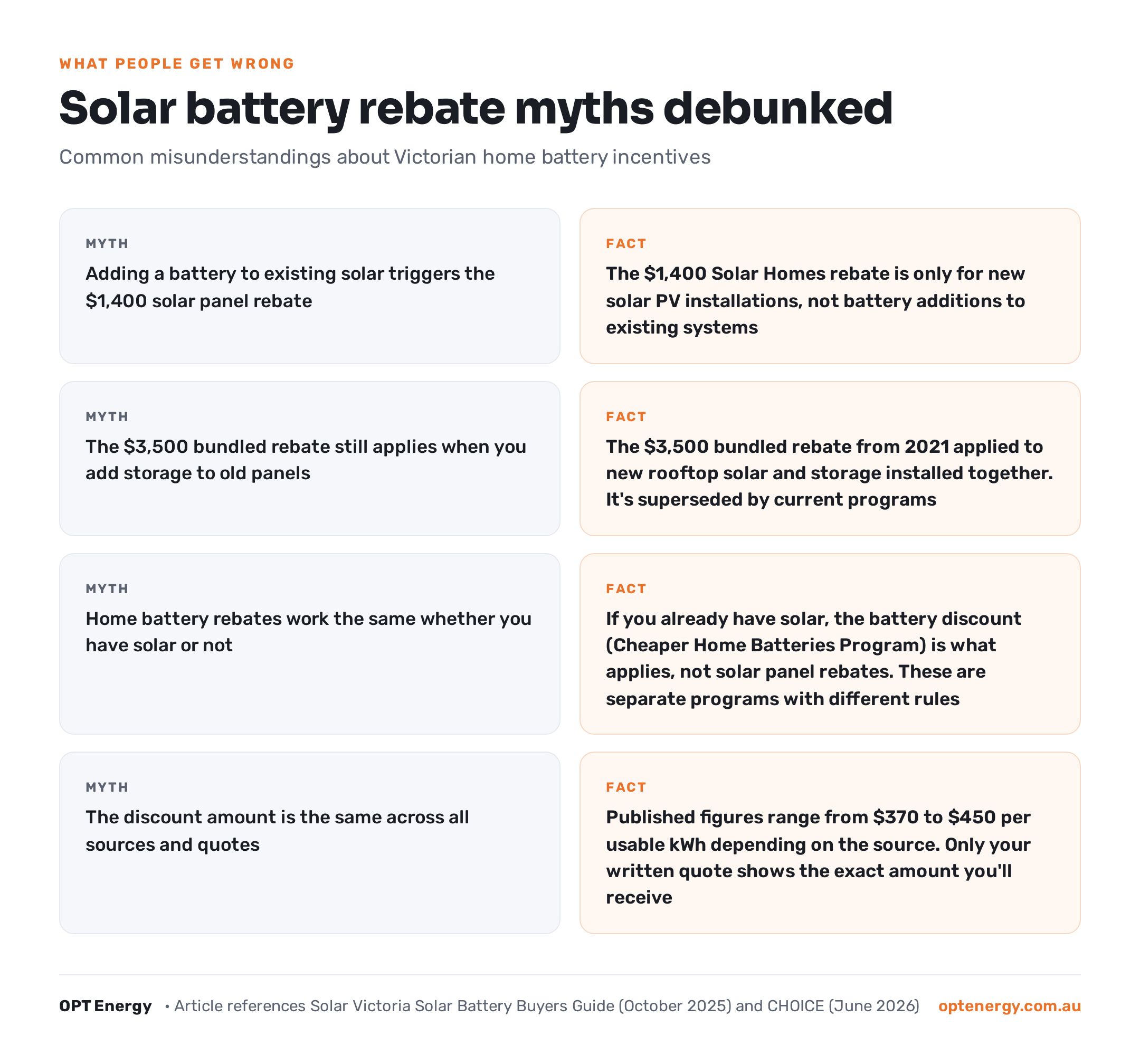
If you already have solar, the incentive that matters is the battery discount, not the solar panel rebate. These are separate programs with separate rules. Mixing them up is the most common reason people expect a figure they never receive.
The main storage incentive right now is the federal Cheaper Home Batteries Program. It gives an upfront discount based on the usable capacity of the system, measured in kilowatt hours (kWh). Sources published in 2026 quote different amounts. One installer describes it as a 30% upfront discount of roughly $370 per usable kWh. CHOICE reported in June 2026 that eligible applicants can access $450 per usable kWh, up to $6000, and its headline flagged big new changes. Because the figures differ, don’t plan around any single number. Check the official program page and your written quote for the exact amount.
Older Victorian rules cause most of the confusion:
- The Solar Homes $1,400 rebate is for new solar PV installations for eligible owner occupiers. It isn’t a storage rebate, so adding a battery to panels you already own won’t trigger it.
- The $3500 bundled rebate from 2021 applied when households installed new rooftop solar and storage together. It’s a historical rule and is likely superseded.
- Interest free loans of up to $8,800 still appear on some websites. That conflicts with the upfront discounts described elsewhere, which shows how much these details have shifted.
Solar Victoria’s Solar Battery Buyers Guide is written for households that already have solar PV and want to add storage. It’s a useful starting point. It was last dated October 2025, though, so treat any rebate amounts in it as possibly out of date.
The checklist: eight things to confirm before you sign
Work through this list before you accept any quote. If you can’t tick an item, ask your installer to confirm it in writing.
| Check | Why it matters | What to have ready |
|---|---|---|
| Your solar system is installed and working | The discount is assessed on the storage you add, not your panels | A recent electricity bill and your original solar paperwork |
| The usable capacity in kWh | The discount is calculated per usable kWh | The spec sheet showing usable, not total, capacity |
| Which program is paying | Solar PV rebates, the old bundled rebate and loan schemes all work differently | The program name written on your quote |
| Inverter compatibility | Your current inverter may not support storage | The inverter brand and model, or a photo of its label |
| Past energy incentive claims at the address | Your installer needs this to assess eligibility properly | Any old rebate or VEU paperwork you kept |
| Who owns the property | Some Victorian rebates, such as the Solar Homes PV rebate, are limited to owner occupiers | A rates notice, or written landlord consent if you rent |
| How the claim will be lodged | Solar Victoria runs claims through authorised retailers who log in to submit them | Ask the installer to explain who lodges the storage claim |
| The discount on a formal written quote | The only figure that counts is the one you agree to | A written quote before you commit to anything |
Check your existing inverter first
Your inverter is the part most likely to change the price. Many older systems use a string inverter that only handles power from the panels. To add storage, the installer will usually either replace it with a hybrid inverter or fit an AC coupled system that brings its own inverter.
Take a clear photo of the label on your inverter before you ask for a quote. It saves a site visit and gets you a more accurate price sooner. Any electrical work on the switchboard or inverter must be done by an appropriately licensed electrician.
Work out usable capacity, not the headline size
Storage systems often list two numbers: total capacity and usable capacity. Both CHOICE and installer sources describe the discount as being calculated on usable capacity. A unit advertised at one size may attract a discount based on a smaller figure.
Size the system to your evening use, not to the biggest discount. Look at your bill or your retailer’s usage data for what you draw after the sun goes down. If you export most of your solar at midday and then buy power from the grid between 6pm and bedtime, that evening gap is what storage is there to cover.
Three situations we see with existing solar
These are the patterns that come up most often when people with panels ask us about storage.
The household working from an old article. They installed solar a few years ago and read about a $3500 rebate for adding storage. That rule applied to bundling new panels with a battery, and it’s no longer the one to plan around. Once the current program is explained, the numbers usually still make sense. They’re just different from what was expected.
The older system with a string inverter. The storage discount applies, but the quote also includes a new inverter. In this case, ask for the quote to show the discount and the inverter cost as separate lines. That way you can see exactly what the incentive covers and what you’re paying for in full.
The household going further with electrification. Some homes want storage because they’re also moving away from gas. Solar Victoria has said going all electric with solar PV can cut energy bills by more than $1,000 a year. That’s a general figure about solar and electrification, not a promise about storage. If hot water is part of your plan, our guide to the heat pump hot water rebate in Victoria explains how that discount works. It’s worth reading alongside our guide to choosing the best hot water system for your home, which compares the hot water options Victorian households commonly weigh up.
Frequently asked questions
Is the Victorian $1,400 solar rebate available for a battery?
No. The Solar Homes $1,400 rebate is for new solar PV installations for eligible owner occupiers. If you already have panels and want to add storage, look at the battery discount instead and confirm the program name on your quote.
Do my panels need to be a certain age to add storage?
The guidance we’ve reviewed for adding storage to existing solar focuses on the new equipment and your eligibility, not the age of your panels. The practical questions are whether your inverter and switchboard can support storage, and whether your panels still produce enough to charge it.
How do I find out exactly how much discount I’ll get?
Check the official program page for current rates, then compare it with your formal written quote. Published figures have changed during 2026 and different sources quote different amounts. The figure on the quote you accept is the one that applies to you.
Next step: check your home before you commit
The fastest way to know where you stand is to have your setup assessed against current rules. When you come to us, the process runs in five steps:
- Enquiry. You tell us about your solar system and what you want storage to do.
- Eligibility assessment. We check which programs you may qualify for.
- Tailored quote. You get a formal written quote showing the expected discount.
- Rebate confirmation. The incentive is confirmed before work is booked.
- Scheduled installation. The install goes ahead at a time that suits you.
No installation goes ahead until you’ve received and accepted a formal written quote, and you’re under no obligation before then. If you accept and then cancel before installation, a $200 cancellation fee applies. If unexpected costs come up on the day, we tell you straight away and you’re under no obligation to proceed. If the job can’t be completed as quoted, we restore your property to how it was.
We can’t guarantee the availability or amount of any government incentive. If a household turns out to be ineligible, the indicative price won’t be achievable and the actual price will be higher. That’s why we confirm eligibility before anything is installed.
On site, our crews work around your household. One family who had five split systems installed told us the team worked all day through the rain, planned around their baby’s naps, and took every box away when they left. You can expect the same care with a storage install.
For a wider view of what’s on offer, read our overview of energy rebates in Victoria. When you’re ready, contact us with a photo of your inverter label and a recent bill, and we’ll tell you what you’re likely eligible for.


